
A newly identified microscopic organism is challenging long-held assumptions about how hot complex life can survive. Scientists have discovered a single-celled amoeba capable of thriving in temperatures that would kill all previously known eukaryotic life — the category that includes animals, plants, and all organisms whose cells contain a nucleus.
This remarkable finding suggests that the upper temperature limits of eukaryotic cells may be far higher than researchers once believed. “We need to rethink what’s possible for a eukaryotic cell in a significant way,” says Angela Oliverio, a microbiologist at Syracuse University in New York. Oliverio and her colleague, microbiologist Beryl Rappaport, described their work in a preprint made public on November 24.
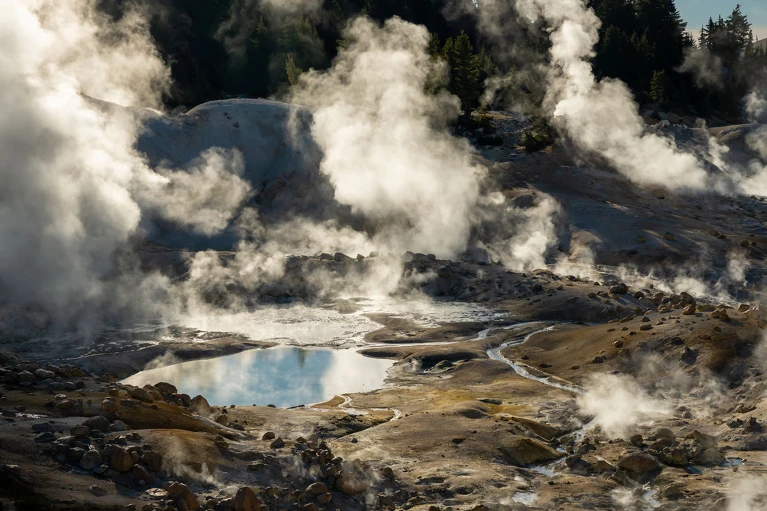
The discovery took place in Lassen Volcanic National Park, located in California’s Cascade Range. Known for its boiling pools, acidic lakes, and geothermal activity, the park has long captivated microbiologists searching for unusual life forms. Yet the organism in question was found not in one of its dramatic, steaming hot springs, but in a relatively ordinary feature — a neutral-pH hot stream that, according to the researchers, appeared unremarkable at first glance. They named the new species Incendiamoeba cascadensis, meaning “fire amoeba from the Cascades.”
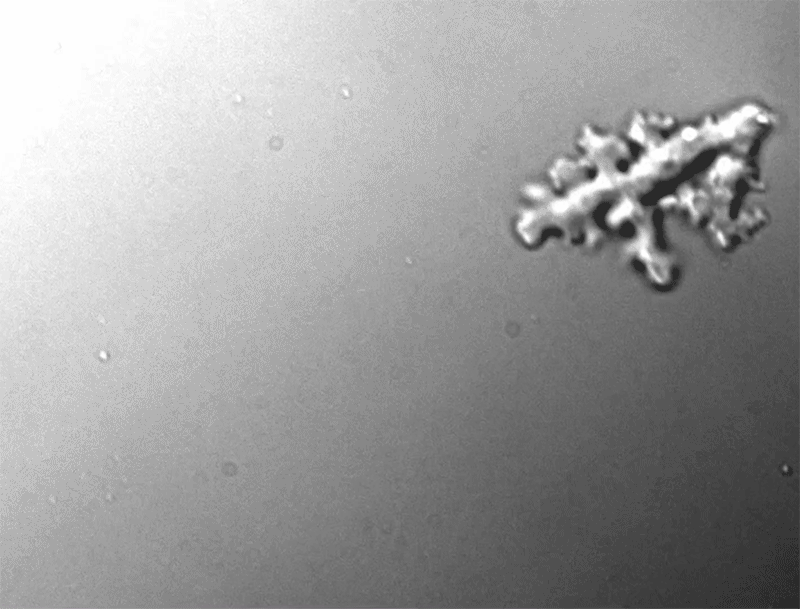
When the team collected water samples from the stream, initial microscopic observations revealed no obvious signs of life. But once the samples were cultured with nutrients, tiny amoebae appeared — and then continued to grow at temperatures of 57 °C, matching the stream’s natural heat level. The researchers gradually increased the temperature and watched as the organism surpassed the previous maximum known limit for eukaryotes, which was around 60 °C.
I. cascadensis continued dividing at 63 °C and remained active at 64 °C. When exposed to temperatures as high as 70 °C, where eukaryotic cells should not function at all, the organism shifted into a dormant cyst state. These cysts could later reactivate into living, moving cells once temperatures cooled, demonstrating a level of thermal resilience previously unseen in complex life.
Although bacteria and archaea can tolerate far more extreme conditions — the archaeon Methanopyrus kandleri, for instance, survives at a record 122 °C — eukaryotes have historically appeared far more fragile. Before this discovery, only a few species of fungi and red algae held the eukaryotic heat tolerance record. Human and other mammalian cells generally fail above 43 °C, highlighting the dramatic gap between typical eukaryotic biology and the extremes now observed in I. cascadensis.
For evolutionary biologists, the finding is a reminder of how much remains unknown about Earth’s most unusual organisms. Julia Van Etten, a researcher at the University of Maryland, College Park, notes that exploring overlooked environments continues to reveal life forms that defy expectations. “This group discovered one that’s doing something we didn’t know eukaryotes were capable of,” she says. “So what else is out there?”
Oliverio agrees that the discovery opens new questions about the limits of biology. She points out that eukaryotes capable of withstanding extreme conditions have often been neglected in scientific studies, despite their potential to reshape our understanding of life’s adaptability. Such organisms may also contribute insights relevant to the search for extraterrestrial life and to emerging biotechnologies that rely on stable organisms operating under harsh conditions.
“We looked in one stream,” Oliverio says. “Maybe we were extremely lucky and found a rare exception, but we really don’t think that’s the case.” Their work suggests that Earth’s extreme environments — from volcanic regions to deep-sea vents — may hold far more undiscovered forms of complex life than previously imagined.
Leave a Reply