
Around 150 million years ago, Europe looked nothing like it does today. Much of the continent lay beneath warm, shallow seas, and its landmass sat far closer to the equator. What is now Germany and nearby regions consisted of scattered islands rising out of tropical waters.
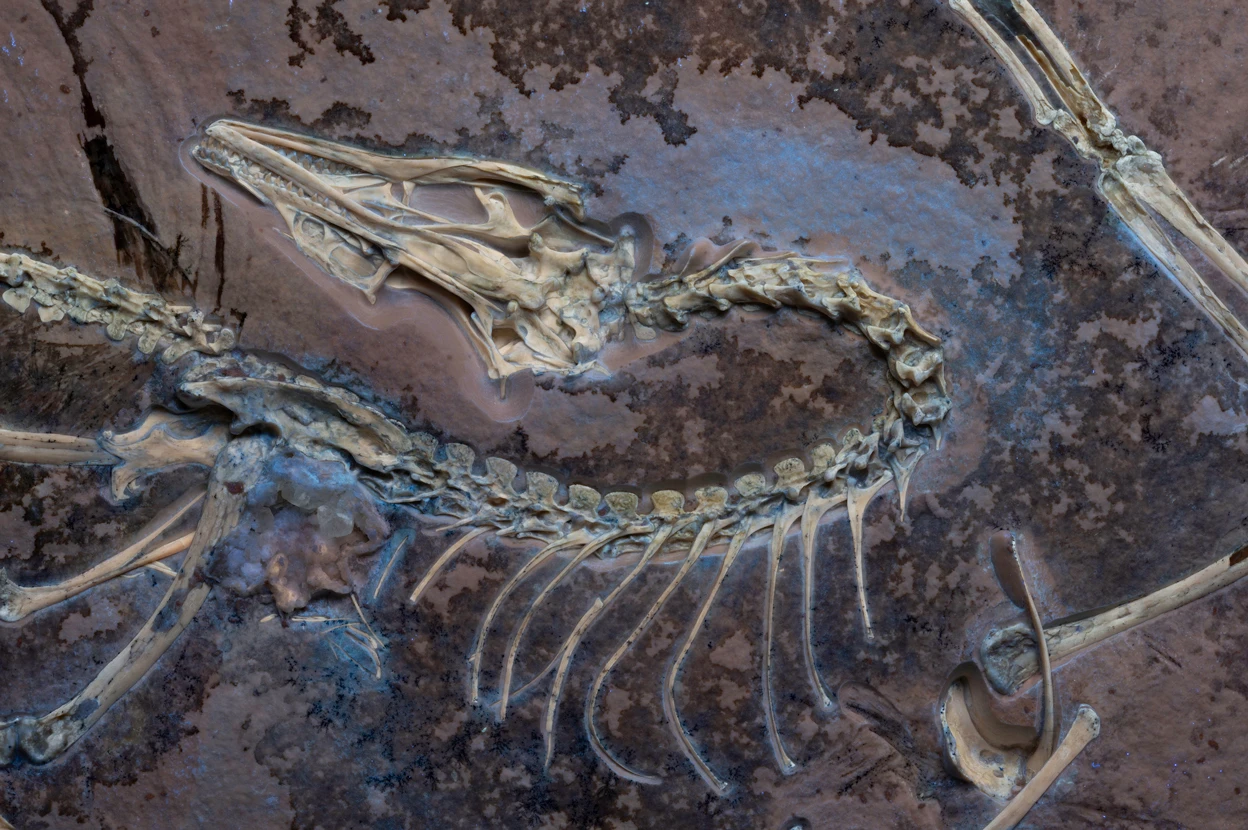
On some of these islands lived animals that seemed strangely out of place. Roughly the size of modern crows, covered in dark feathers and likely feeding on insects, they spent most of their time on the ground. When threatened, they could flap into the air, but they were far from skilled fliers. Even more unusual, they bore features no modern bird possesses: teeth in their jaws and clawed fingers at the ends of their wings. These animals were Archaeopteryx, often described as one of the earliest birds, and they still carried clear traces of their dinosaur heritage.
Archaeopteryx fossils are among the most iconic in the history of paleontology, yet the creature has long puzzled scientists. For more than a century, it stood alone as the only known bird from the Jurassic period, the era when birds first appeared. While many ancient birds have since been discovered, all of them came from the later Cretaceous period, when birds had already diversified and spread widely. The very beginnings of bird evolution remained frustratingly obscure.
That situation has recently begun to change. In February 2025, researchers described a newly discovered Jurassic bird from China, naming it Baminornis. This find instantly broadened scientific understanding of early birds. Unlike Archaeopteryx, Baminornis shows that early avian evolution was already more complex than previously assumed. At the same time, the detailed study of an exceptionally well-preserved Archaeopteryx specimen, hidden from science for decades, has offered fresh insight into the anatomy and lifestyle of the first birds. Together, these discoveries are reshaping ideas about how birds evolved and whether powered flight emerged once or multiple times during the dinosaur age.
From land dwellers to masters of the air
Today, birds are among the most diverse and successful animal groups on Earth, with roughly 10,000 known species. They range from tiny hummingbirds capable of hovering in place to globe-spanning travelers like the wandering albatross, as well as apex predators such as eagles and large flightless birds like emus.
Over the last fifty years, scientists have firmly established that birds evolved from theropod dinosaurs, the same group that includes Velociraptor and the massive Allosaurus. Yet tracing the precise steps of this transformation has proven extremely difficult.
Bird fossils are rare, explains paleontologist Jingmai O’Connor of the Field Museum in Chicago. Their scarcity is largely due to anatomy. Early birds were small, with light, hollow bones that crushed easily. In harsh environments, delicate skeletons were far less likely to survive than the massive bones of creatures such as Tyrannosaurus rex.
This makes the preservation of Archaeopteryx fossils all the more remarkable. The first discoveries in the 1860s included a single feather, the first fossil feather ever identified, followed by a headless skeleton. Their timing was significant. Just a few years earlier, Charles Darwin had published On the Origin of Species, outlining the concept of evolution by natural selection. Archaeopteryx quickly became a textbook example of a transitional fossil, combining bird-like feathers with dinosaur-like anatomy.
For decades, scientists have debated two central questions: could Archaeopteryx truly fly, and should it be considered a bird at all? It possessed advanced flight feathers similar to those of modern birds, but other features suggested limitations. Its long, bony tail resembled that of predatory dinosaurs and would have made stable flight difficult. Modern birds, by contrast, have short tails that help with balance and maneuverability.
Another puzzle is the apparent absence of a sternum, the breastbone that anchors powerful flight muscles in living birds. Some researchers suggest that Archaeopteryx may have had a cartilage sternum that failed to fossilize, but cartilage would have provided weaker muscle attachment. If Archaeopteryx could fly, it was likely inefficient, perhaps comparable to the short, clumsy flights of modern chickens.

A long gap in the record
Despite all that Archaeopteryx has revealed, it represents just a single snapshot in time. All known fossils come from one region in Germany, preserved under extraordinarily rare conditions. Calm lagoon waters allowed bodies to settle and fossilize gently, an unlikely scenario that happened to occur at exactly the right moment.
Archaeopteryx dates to about 150 million years ago, near the end of the Jurassic period. After that, the fossil record goes silent. For millions of years, no birds are known at all.
In the Cretaceous period that followed, the situation changes dramatically. Fossil sites in Spain and, especially, northeastern China have yielded a wealth of bird and bird-like dinosaur remains. These discoveries show that by around 135 million years ago, birds had already diversified and spread across much of the globe. Many of these lineages later went extinct in the mass extinction event that ended the age of dinosaurs.
Yet the late Jurassic remained nearly empty of bird fossils, with Archaeopteryx standing alone, until the discovery of Baminornis.
A second Jurassic bird emerges
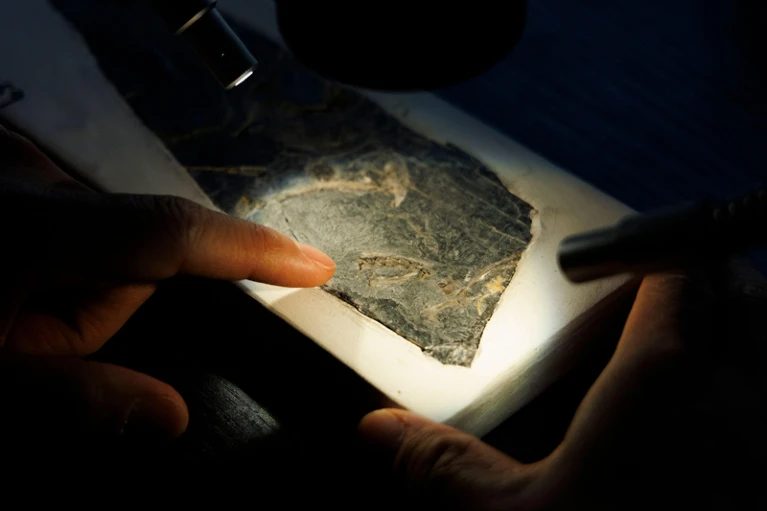
Beginning in 2022, paleontologist Min Wang and his colleagues explored the Zhenghe Fauna in southeastern China. Early finds included Fujianvenator, a bird-like dinosaur with long legs that may have waded in shallow water. The site, dated to roughly the same age as Archaeopteryx, showed signs of wetlands, an environment well suited to preserving delicate remains.
Their efforts paid off with the discovery of Baminornis. This small bird weighed only a few hundred grams, but it displayed a striking feature: a short, fused tail ending in a pygostyle, the same structure seen in modern birds. Archaeopteryx lacks this feature, retaining a long, unfused tail.
The presence of a fully developed pygostyle in such an early bird was unexpected. It suggests that bird evolution began earlier than once thought and that different bird forms coexisted during the Jurassic. Some researchers believe this points to an even earlier origin of birds, possibly in the middle or early Jurassic.
Others urge caution, noting that interpretations of new fossils can change with further study. Still, the differences between Archaeopteryx and Baminornis strongly imply that birds were already experimenting with different body plans and flight styles by the end of the Jurassic.
Multiple paths to flight?
The broader fossil record hints at something even more surprising: flight may have evolved more than once among dinosaurs. Fossils such as Microraptor, a four-winged dinosaur from China, suggest a flying strategy very different from that of birds. Another dinosaur, Yi, appears to have flown using membranous wings similar to those of bats rather than feathers.
Some scientists interpret these examples as evidence for multiple independent origins of flight. Others argue for a single evolutionary origin, followed by numerous experimental offshoots that explored alternative designs. Resolving this debate will require more fossils and a clearer picture of how these species are related.
New life for an old fossil
Even after more than 160 years of study, Archaeopteryx continues to surprise researchers. In 2025, scientists described a newly analyzed specimen housed at the Field Museum in Chicago. Unlike most previous hookups, this skeleton is nearly complete and uncrushed.
The specimen revealed specialized feathers that helped create a continuous wing surface, improving lift. These features can now serve as clues for assessing flight ability in other bird-like dinosaurs. The skull also provided new information about feeding mechanics, showing that aspects of the modern bird palate were already present.
Further studies suggest that Archaeopteryx had adaptations for rapid feeding, supporting the high energy demands of flight. Together, these findings indicate that many traits required for advanced aerial movement were already emerging in the late Jurassic.
With discoveries accelerating in recent years, paleontologists are optimistic. Each new fossil adds another piece to the puzzle of how birds rose from the ground and ultimately conquered the skies.
Leave a Reply