

For more than a hundred years, biologists largely agreed on a simple answer to a profound question: which animals appeared first on Earth? The prevailing view held that sponges were the earliest animal lineage. These stationary, filter-feeding organisms lack muscles, nerves, and most specialized tissues, making them seem like a natural starting point for animal evolution.
That consensus was shaken in 2008, when a genomic study proposed a surprising alternative. According to the study, comb jellies—also known as ctenophores—may have been the first animals to branch off the evolutionary tree. Unlike sponges, comb jellies are active predators with nerves, muscles, and complex body structures. The idea that such sophisticated creatures could predate simpler animals ignited one of evolutionary biology’s most intense debates.
Nearly two decades later, the argument shows little sign of resolution. Dozens of studies have revisited the same datasets using different methods, often reaching opposite conclusions. Instead of converging on an answer, the field has become deeply divided.
“What could have been a collaborative search for the truth turned into something more like a battle,” says Nicole King, an evolutionary biologist at the University of California, Berkeley. King co-authored a paper last November that cautiously supported the sponge-first hypothesis. However, after technical flaws were identified post-publication, she and her co-author requested that the paper be retracted. The experience has made her reconsider whether she wants to remain involved in the debate at all.
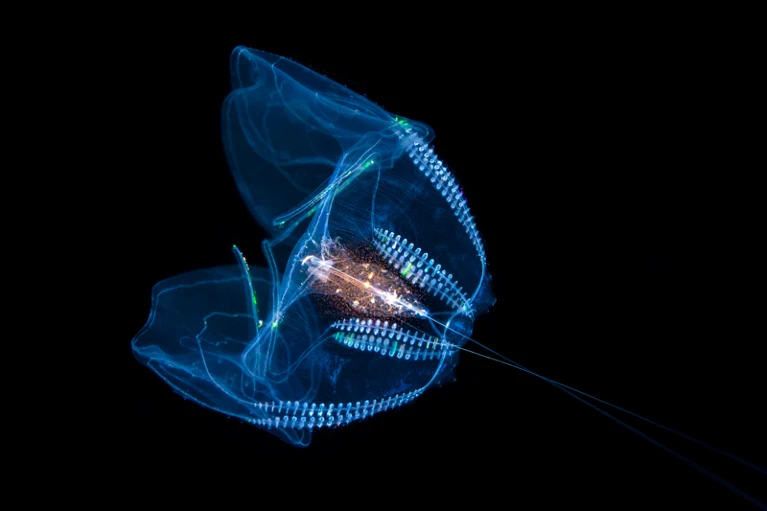
Many researchers now argue that progress will require a shift not only in methods, but also in mindset. Rather than working in opposing camps, scientists from both sides may need to collaborate more closely. “We have to think beyond traditional approaches,” says Leonid Moroz, a neuroscientist at the University of Florida whose research has long supported comb jellies as the earliest animal lineage.
The rise of the first animals
Between 600 million and 800 million years ago, life on Earth underwent a dramatic transformation. For billions of years, life consisted entirely of single-celled organisms. Then, multicellular animals emerged—organisms made up of many interacting cells with specialized roles. This innovation triggered an explosion of new body forms and biological capabilities.
Within what may have been just tens of millions of years, five major animal groups appeared. These included the ancestors of modern sponges and comb jellies, as well as placozoans, cnidarians such as jellyfish and sea anemones, and bilaterians. Bilaterians, which show mirror-image symmetry early in development, would eventually give rise to most familiar animals, from insects and mollusks to humans.
Fossils from this period are rare and often ambiguous, consisting of little more than cavities or tube-like structures. As a result, identifying which modern animals most closely resemble the earliest ones has become a key strategy for reconstructing early animal evolution. “Knowing which lineage came first won’t tell us everything,” says Max Telford, an evolutionary biologist at University College London, “but it does give us important clues about what those first animals might have been like.”
For decades, sponges were placed at the base of the animal family tree because of their apparent simplicity. They lack nerves, muscles, and digestive systems, features that were assumed to have evolved later. “If sponges really are the earliest branch, the evolutionary story feels neat and intuitive,” Telford says. But when scientists began using genome-scale data to test this assumption, the picture became far more complicated.
A debate fueled by genomics
The turning point came with advances in DNA sequencing in the early 2000s. Faster and cheaper technologies made it possible to compare thousands of genes across many species. Casey Dunn, now an evolutionary biologist at Yale University, was part of a team that set out to reconstruct the animal tree of life using these new tools.
Their 2008 study analyzed gene sequences from 77 organisms, including sponges, sea spiders, corals, and, for the first time, comb jellies. The researchers expected to confirm the traditional view. Instead, their analysis suggested that comb jellies—not sponges—were the sister lineage to all other animals.

The reaction was immediate and polarized. Some scientists welcomed the result as an opportunity to rethink long-held assumptions. Others rejected it outright, arguing that sponges had always been, and would always remain, the earliest animals.
Since then, paper after paper has supported one side or the other. Some studies favored comb jellies at the root of the animal tree, while others reaffirmed sponges’ position. Each new publication was often presented as decisive, both in academic journals and in media coverage. According to King, this back-and-forth hardened positions rather than resolving uncertainties.
The comb-jelly hypothesis raises difficult questions. If the earliest animals already had nerves and muscles, why do sponges lack these features today? One possibility is that complex traits evolved multiple times independently. Another is that early animals possessed these traits, but some lineages, including sponges and placozoans, later lost them.
Disciplinary background appears to influence which explanation scientists find more plausible. Researchers trained in zoology and evolutionary developmental biology often favor gradual increases in complexity and tend to support the sponge-first model. Genomicists, by contrast, are generally more comfortable with the idea that complexity can emerge, disappear, and re-emerge over evolutionary time, making them more receptive to the comb-jelly hypothesis.
Reconstructing a distant past
Trying to infer events from hundreds of millions of years ago using modern genomes is extraordinarily challenging. Antonis Rokas, an evolutionary geneticist at Vanderbilt University, compares the task to studying the early Universe by observing faint cosmic signals. The information scientists seek is weak, ancient, and easily distorted.
The key lies in detecting subtle genetic differences that arose during a very narrow window—after the first animal lineage split off, but before the next divergence occurred. That window may have lasted less than five million years, giving little time for distinctive genetic changes to accumulate. Over the subsequent 600 million years, later mutations would have further obscured those early signals.
As a result, small methodological choices can have outsized effects. Rokas and his colleagues showed in a 2021 analysis that conclusions can depend heavily on which non-animal species are included for comparison and on assumptions about how genes evolve. “Everyone involved is acting in good faith,” says Sean Carroll, an evolutionary biologist at the University of Maryland. “But the problem itself is brutally hard.”
New strategies and setbacks
To move forward, many scientists argue that entirely new approaches are needed. One promising strategy focuses not on gene sequences, but on the physical arrangement of genes along chromosomes. These large-scale genomic structures change far less frequently and are unlikely to revert once altered, potentially preserving clearer traces of deep evolutionary history.
Using this method, a 2023 study led by Darrin Schultz, now at Stanford University, found strong support for comb jellies as the earliest animal lineage. The researchers identified chromosome-level patterns shared between comb jellies and single-celled relatives of animals that were absent in sponges and other groups.
King’s now-retracted paper was another attempt to bring fresh thinking to the problem. She and her colleague Jacob Steenwyk analyzed multiple datasets using a wide range of methods in hopes of identifying gene groups that consistently favored one hypothesis. Their cautious conclusion supported sponges but emphasized that the debate was unresolved.
However, after other researchers identified technical errors in the analysis, King and Steenwyk acknowledged the mistakes and requested a formal retraction. Corrected analyses, according to Dunn and his collaborators, strongly favor comb jellies instead. For King, the episode was a sobering reminder of how fragile conclusions can be in such a contentious field.
Despite the tension, many researchers believe the debate has driven valuable discoveries. Studies inspired by the controversy have revealed, for example, that comb jelly nervous systems are fundamentally different from those of other animals, lacking traditional synapses. These findings have reshaped understanding of how nervous systems can evolve.
Although some scientists expect the question of the first animal lineage to take decades to settle, few believe the effort is wasted. More genomes from sponges and comb jellies are urgently needed, and fieldwork continues in remote locations to collect new specimens.
“People often describe this as a scientific stalemate,” Dunn says. “But in reality, we’re learning an enormous amount about early animal evolution along the way.”
Leave a Reply