
The streets of Nuuk, Greenland, were unusually lively in November. The crowds gathering across the Arctic capital were not demonstrators or military personnel, but scientists from around the world arriving to exchange ideas and findings. They had come for Greenland Science Week, a major research conference held under the theme “All Eyes on Greenland.” The title felt especially timely, as global attention had recently intensified following remarks by U.S. President Donald Trump expressing interest in taking control of the island — comments that sparked widespread international debate.
Greenland, known locally as Kalaallit Nunaat and operating as an autonomous territory within the Kingdom of Denmark, plays a critical role in global scientific research. In recent years, its importance has only grown. Over the past five years, Greenland’s government has actively elevated science as a national priority, investing in research infrastructure and strengthening cooperation between local researchers and the international scientific community.
On January 21, tensions eased slightly when Trump stated that the United States would not use military force to seize Greenland. However, he simultaneously reiterated his wish for the U.S. to gain what he described as “total” access to the territory, speaking to reporters after attending the World Economic Forum in Davos, Switzerland. Further discussions between U.S. and European leaders are expected, and uncertainty remains high. For now, how these geopolitical developments might affect scientific research in Greenland is still unclear.
A uniquely valuable research environment
Scientific activity in Greenland has deep roots, drawing from Inuit traditional knowledge, early European polar expeditions, and research conducted during U.S. military operations. By the 1990s, Greenland had emerged as a global focal point for climate research, particularly after European and American teams drilled deep ice cores into the ice sheet, unlocking records of Earth’s climate history stretching back hundreds of thousands of years.
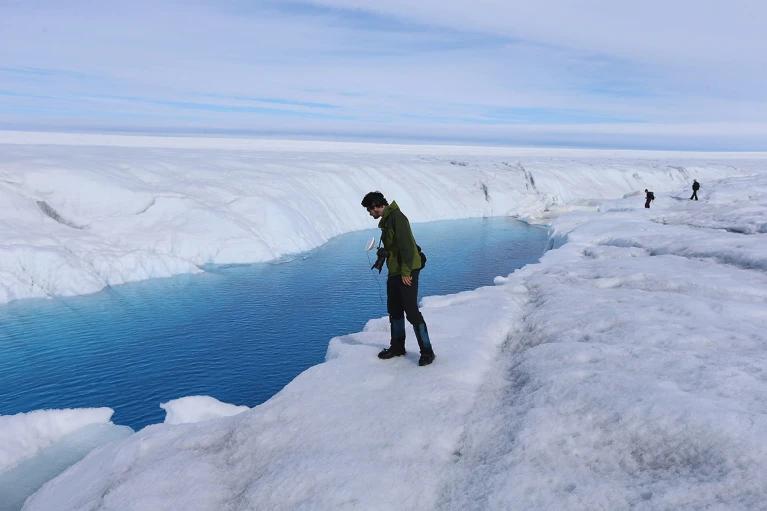
Today, Greenland remains central to climate science. Researchers from across the globe monitor, analyze, and model changes in its massive ice sheet. If the ice sheet were to melt entirely, global sea levels would rise by approximately 7.4 meters. In the past year alone, Greenland lost an estimated 129 billion tonnes of ice and now accounts for roughly 20 percent of current global sea-level rise, equivalent to about 0.8 millimeters per year.
Yet climate change is only part of the story. According to Greenland’s first-ever national research strategy, released in 2022, the island’s scientific value extends far beyond ice and temperature data. Greenland is a key site for geological and mineral research, thanks to its ancient and distinctive geology. Scientists believe it may hold significant reserves of critical raw materials, including lithium, which are essential for renewable energy technologies and electric vehicles.
Greenland also offers rare opportunities for genetic and biomedical research. Its predominantly Inuit population has lived in relative isolation along the island’s icy coastline for thousands of years. This long-term isolation has led to genetic and physiological adaptations that are found nowhere else, making Greenland an important location for studying human health, genetics, and disease resilience.
The 2022 research strategy outlines priorities through 2030 and emphasizes that scientific work should be rooted in Greenland, address local social needs, and remain open to international collaboration. It also stresses that research findings should be widely accessible, benefiting both local communities and the global public.
A growing scientific community
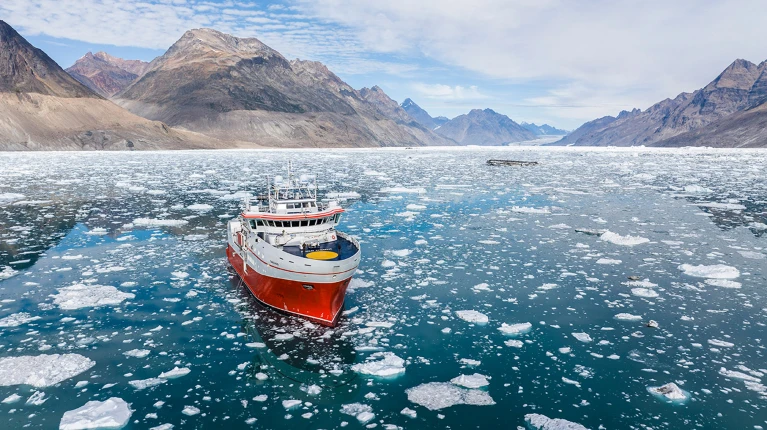
This national strategy has helped strengthen Greenland’s small but expanding research community. One of the most significant investments is the research vessel Tarajoq, the largest single research project ever funded by Greenland’s government. The ship entered service in 2022, with a total cost of 235 million Danish kroner, equivalent to about 37 million U.S. dollars, funded jointly by the government and private foundations.
In August of last year, Tarajoq supported an expedition led by Fiamma Straneo, a polar scientist at Harvard University. Her team traveled to eastern Greenland to study how glacial meltwater interacts with the ecosystems of Arctic fjords. Thanks to the vessel’s maneuverability, researchers were able to operate close to shore and deploy instruments critical for long-term monitoring. According to Straneo, the ship has become an indispensable tool for advancing Arctic research.
Greenland has also invested in digital infrastructure. Last year, the Greenland Institute of Natural Resources in Nuuk installed the territory’s first artificial intelligence–enabled computing systems. These new resources allow scientists to process large datasets much faster than before. Researchers now use AI to identify marine species from underwater video and acoustic recordings, a task that previously took weeks or even months. With the new system, scientists can quickly model and predict the distribution of fish and other marine life in Greenlandic waters, supporting both research and sustainable resource management.
Uncertain times for collaboration
Despite this progress, Greenland’s research ecosystem remains heavily dependent on international partnerships. Much of its funding comes from Denmark, other Nordic countries, and private foundations. Major support also comes from European institutions. For example, the European Research Council is financing a €13 million project set to begin in March, which will examine how climate change affects the ability of the upper layers of Greenland’s ice sheet to retain meltwater.
To better manage growing scientific interest, Greenland’s government has worked to streamline the process for visiting researchers. It has established a centralized permit system and, in 2021, helped launch the Arctic Hub — an initiative designed to connect local researchers with international teams and ensure more coordinated, ethical, and efficient research activities.
However, rising geopolitical tensions could complicate these collaborations. Some scientists worry that disagreements between the United States and Europe over Greenland’s future may make joint research efforts more difficult. Kerim Hestnes Nisancioglu, a climate scientist at the University of Bergen in Norway, has suggested that cooperation involving U.S., Norwegian, and Greenlandic researchers could become more challenging under strained political conditions.
Many researchers have chosen not to comment publicly, citing the rapidly changing situation and concerns about disrupting international partnerships. Mari Kleist, head of the Greenland Research Council in Nuuk, has emphasized that geopolitical analysis falls outside her professional role, highlighting the cautious approach many in the scientific community are taking as events continue to unfold.
As global attention remains fixed on Greenland, its scientific significance is unlikely to diminish. Whether future political developments will support or hinder this growing research landscape remains an open question.
Leave a Reply