
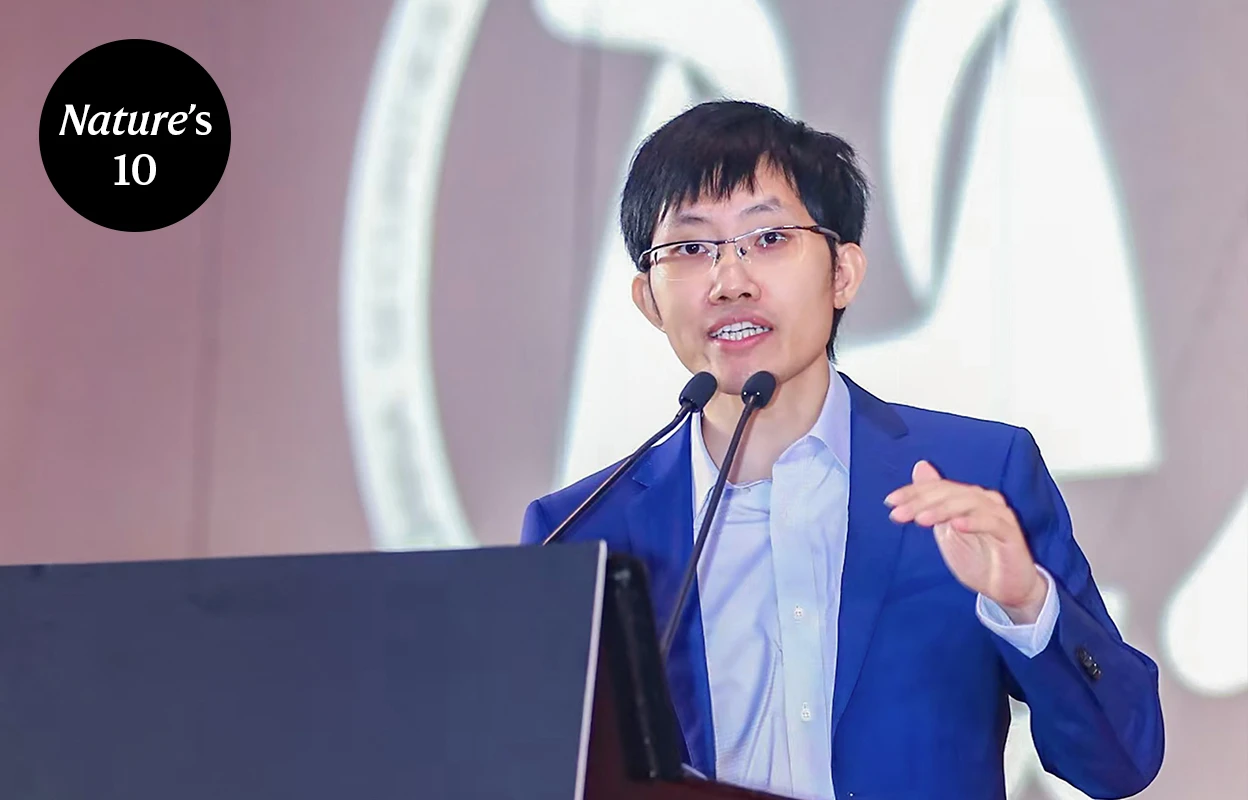
When the Chinese AI company DeepSeek revealed its R1 model earlier this year, the announcement sent immediate shockwaves through the global tech community. The model arrived without warning, yet its impact was unmistakable: it challenged the long-held assumption that the United States maintained a wide lead in advanced artificial intelligence. Instead, the debut of R1 suggested a rapidly shifting balance — one where innovation was becoming far more international and unpredictable.
At the center of this unexpected breakthrough is the company’s elusive founder, Liang Wenfeng. Now 40, Liang once worked in finance and is widely believed to have earned millions through algorithmic trading. In 2023, armed with capital and a clear vision, he established DeepSeek in Hangzhou. Despite leading one of China’s most closely watched AI firms, Liang keeps a low profile and rarely accepts interviews, preferring to stay focused on research over publicity.
What Liang chooses not to say publicly, however, is expressed through the openness of his company’s technology. DeepSeek’s R1 model is a sophisticated reasoning-focused large language model (LLM) designed to tackle difficult problems in mathematics, coding, and logical analysis by breaking tasks into meticulously structured steps. In a field dominated by expensive, closed-source models, R1 stood out immediately: it was released with open weights, enabling anyone to download, examine, and build upon it freely. For researchers working in specialized domains, this level of access was a rare and valuable opportunity.
Industry observers say R1’s release pushed other AI firms — both in China and the United States — to consider similar open-source strategies. But even more striking was the model’s efficiency. Although R1 performs competitively with the most advanced American models, experts report that its training costs were dramatically lower. Meta’s Llama 3 405B model, for instance, cost more than ten times as much to train. DeepSeek further distinguished itself by publishing an unusually detailed account of how R1 was developed and trained. In September, it became the first major LLM to complete peer review, offering the global research community a transparent look at the methods behind its impressive performance.
According to researchers such as Adina Yakefu from Hugging Face, DeepSeek’s influence has already cascaded across the field. The company has demonstrated that powerful reasoning models do not necessarily require massive budgets — only strategic design and thoughtful engineering.
Liang’s journey into AI could hardly have started farther from the international spotlight. Growing up in a small village in Guangdong, he was raised by two primary-school teachers and spent his early years far removed from the world of high-technology innovation. His academic path led him to Zhejiang University in Hangzhou, one of China’s most prestigious institutions, where he earned a master’s degree in engineering in 2010. His research focused on algorithms for tracking objects in video — a foundational experience that later shaped his work in both finance and AI.
After graduation, Liang co-founded the hedge fund High-Flyer in 2015, using his understanding of machine learning to develop trading strategies. But even during his years in finance, he was already preparing for something far larger. Starting nearly a decade before founding DeepSeek, Liang began purchasing massive quantities of NVIDIA graphics processing units (GPUs) — ultimately accumulating around 10,000 of them. At the time, China’s access to high-end chips was not yet restricted, and Liang viewed the hardware as a long-term investment in curiosity-driven research.
When US export controls later limited China’s ability to buy top-tier GPUs, DeepSeek found itself in an unusually strong position. In a 2023 interview with Chinese media outlet 36Kr, Liang compared buying GPUs to buying a piano for one’s home — not because it is immediately practical, but because it unlocks creative possibilities for anyone passionate enough to experiment.
Liang’s ambitions extend beyond building a successful AI company. Former employees and industry analysts say he is intent on pursuing artificial general intelligence (AGI), the idea of developing systems with human-level cognitive abilities. To accelerate this mission, DeepSeek has adopted unconventional hiring practices. The company focuses less on traditional credentials and more on individual potential. One of the R1 research paper’s co-authors is still in secondary school. The organizational structure is intentionally flat, allowing researchers of all backgrounds to choose their own projects and contribute directly to core development. According to former team member Benjamin Liu, even interns are given responsibilities typically reserved for full-time researchers.
DeepSeek’s work culture has earned praise not only from insiders but also from external experts. Rather than capitalize on its sudden popularity through aggressive commercialization, the company has remained committed to fundamental research. According to Kwan Yee Ng from the Beijing-based consultancy Concordia AI, DeepSeek stands out for targeting deep, technical problems instead of chasing quick profits.
This dedication has helped integrate DeepSeek’s models throughout everyday life in China. Government agencies are increasingly adopting them to operate public service chatbots and assist citizens with administrative tasks. Meanwhile, millions of people use DeepSeek-powered features on WeChat, one of the country’s most widely used digital platforms. This rapid expansion aligns with China’s broader national strategy to incorporate AI across sectors ranging from urban development to healthcare.
For many Chinese researchers, DeepSeek’s success represents more than just a technological milestone. It symbolizes a shift in global perceptions of Chinese innovation — from being characterized primarily as imitators to emerging as leaders capable of groundbreaking contributions. “The change is real, and it’s accelerating,” says Yu Wu, a researcher at DeepSeek who has witnessed firsthand the company’s rising influence.
As anticipation grows for DeepSeek’s next reasoning model, R2, industry watchers believe it could set another benchmark. Rumors suggest that development has been delayed due to hardware constraints and the complex demands of training. However, many expect Liang to remain committed to openness. According to Wu, DeepSeek intends to keep its future models freely available to the world.
In an era where AI breakthroughs are increasingly shaped by a handful of powerful corporations, DeepSeek’s story offers a counterexample — one driven by transparency, unconventional strategy, and a willingness to challenge global assumptions. Whether R2 surpasses expectations or introduces new limitations, DeepSeek has already altered the trajectory of the AI race. And if the company stays true to its philosophy, its next contribution will once again be shared openly, reshaping the research landscape far beyond China’s borders.
Leave a Reply