
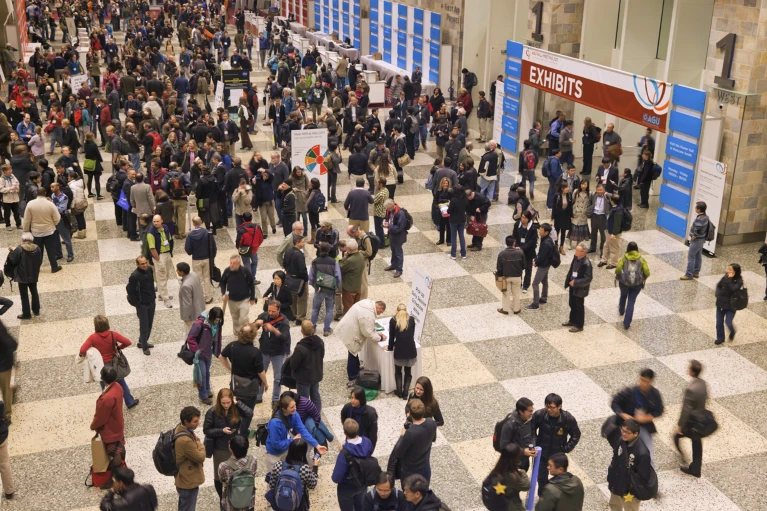
Attendance at several major scientific conferences held in the United States has declined this year compared with last year, and some organizers are already bracing for further drops in 2026. While multiple factors are at play, a growing number of researchers say that policies introduced under U.S. President Donald Trump have made them reconsider traveling to the country.
These challenges have pushed conference organizers to rethink traditional formats and explore alternative ways to bring the global research community together.
Earlier this month, the leading artificial intelligence conference NeurIPS took an unprecedented step by hosting not only its main event in San Diego, California, but also a parallel meeting in Mexico City. The move was intended to ease travel difficulties faced by international participants. At the same time, a group of European AI researchers launched an independent offshoot conference, EurIPS, held in Copenhagen.
“Our goal was to create a space for researchers who felt they had nowhere else to go this year,” said Søren Hauberg, a machine learning and computer vision researcher at the Technical University of Denmark, who helped organize EurIPS.
Noticeably smaller audiences
To understand recent trends, Nature contacted organizers of large conferences scheduled in U.S. cities during the second half of 2025 or early 2026. Of the six conferences that responded, half reported either a decrease in attendance or an anticipated decline compared with the previous year.
In some instances, the drop has been modest and difficult to attribute to a single cause. For example, attendance at the Society for Neuroscience’s annual meeting fell by about 6 percent, from 22,359 participants in 2024 to 21,093 in 2025. The diversity of representation also narrowed, with attendees coming from 73 countries this year compared with 88 the year before. Organizers noted that participation has fluctuated since the onset of the COVID-19 pandemic, making it challenging to isolate the impact of current U.S. policies.
A similar pattern has emerged at the American Geophysical Union’s annual meeting, one of the largest scientific gatherings in the country. More than 30,000 people attended in 2024, while just over 20,000 had registered for the 2025 meeting as it began. Observers noted that poster sessions and exhibition halls appeared less crowded than in previous years.
Rising barriers to participation
For many scientists, traveling to the United States in 2025 has become more complicated due to a series of new restrictions. As part of the administration’s emphasis on immigration enforcement, border officials have increased scrutiny of incoming travelers, with some being denied entry at airports and other checkpoints. In June, the U.S. government imposed entry bans or limitations on citizens from 19 countries, including Iran and Venezuela, citing national security reasons. Later in the year, officials proposed requiring visitors from dozens of countries to submit their social media history from the past five years as part of the entry process.
Beyond immigration rules, other political developments have influenced researchers’ decisions. The Pacifichem conference in Honolulu, which attracted around 11,000 registrants, saw a notable drop in attendance from Canada. According to conference chair Laurel Schafer of the University of British Columbia, this trend mirrors a broader decline in Canadian travel to the United States following the introduction of U.S. tariffs on Canadian goods and comments by Trump suggesting Canada could become “the 51st state.”
Personal safety and identity concerns have also weighed heavily on some scientists. Tanja Junkers, a chemist at Monash University in Melbourne, decided not to attend Pacifichem due to the administration’s stance on gender identity. On his first day in office, Trump issued an executive order stating that there are only two sexes and that the government would enforce laws aligned with that view. Junkers, who identifies as gender-diverse, said she did not feel safe traveling to the United States, even to a state often seen as politically liberal. Although she helped organize a symposium remotely, she did not take part in the meeting itself.
At the same time, increased enforcement actions by U.S. immigration authorities have added to the unease. During the AGU meeting in New Orleans, immigration officers were reported to be active in the surrounding area, and organizers informed attendees that they could not prevent agents from entering the convention center if they chose to do so.
New models for global meetings
In response to these pressures, conference organizers are experimenting with new formats. NeurIPS announced in July that approximately 500 of its expected 26,000 participants would be able to attend the conference from its Mexico City venue instead of San Diego. Organizers cited rapidly growing attendance and ongoing visa challenges as key reasons for offering multiple locations.
The European alternative emerged independently. Hauberg explained that discussions about a Europe-based version of NeurIPS had been ongoing for years, partly due to concerns about climate impact. However, he said recent political changes in the United States ultimately pushed the idea forward.
EurIPS organizers initially hoped to attract around 1,500 participants but were forced to cap attendance after registrations surged to nearly 2,200. Attendees came from 56 countries, including China, India, and Nigeria, exceeding expectations for international participation. According to Hauberg, many conversations during the event centered on the desire for a more welcoming and less confrontational environment.
For Emtiyaz Khan, a machine learning researcher at the RIKEN research institute in Tokyo, the choice to attend EurIPS instead of NeurIPS was straightforward. Given the difficulties many colleagues faced entering the United States, the European conference offered a more accessible option. Khan also appreciated the smaller scale, which made networking and in-depth discussions easier. He described the experience as deeply positive and expressed hope that EurIPS would become a recurring event.
As global science continues to depend on international collaboration, these shifts suggest that where and how researchers meet may be undergoing a lasting transformation.
Leave a Reply