
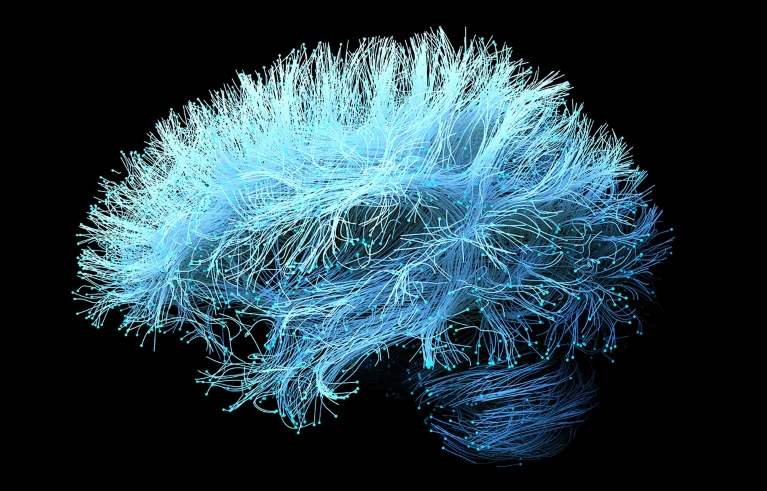
Brain–computer interfaces are advancing at a remarkable pace. In recent years, implanted devices have enabled people with severe disabilities to communicate, and in some cases even sing, in almost real time. Now, a newly launched company says it wants to go a step further: reading brain signals and treating mental disorders without placing electrodes deep inside the brain. Instead, it plans to rely on ultrasound, a form of high-frequency sound waves beyond human hearing.
Merge Labs, which officially launched last month, entered the scene with only a broad description of its mission. It is part of a rapidly expanding brain–computer interface industry, but what sets it apart is its substantial funding — about 252 million US dollars from investors that include OpenAI, the San Francisco-based artificial intelligence company. Many observers see Merge Labs as a potential competitor to Neuralink, Elon Musk’s venture that develops implantable devices capable of recording and influencing brain activity and has already begun human trials.
To better understand the company, Nature spoke with several scientists about who is behind Merge Labs and whether its scientific approach is credible.
Merge Labs describes itself not as a traditional commercial start-up but as a research-driven organization focused on long-term innovation rather than quick profits. It was created as a spin-off from Forest Neurotech, a non-profit research institute based in Los Angeles.
The founding team includes three scientists: Tyson Aflalo, Forest Neurotech’s chief scientific officer; Sumner Norman, its chief executive; and Mikhail Shapiro, a brain–computer interface researcher at the California Institute of Technology who also advises Forest Neurotech. They are joined by tech entrepreneurs Alex Blania and Sandro Herbig, as well as Sam Altman, the chief executive of OpenAI.
Unlike Neuralink’s deeply implanted electrodes, Merge Labs is pursuing ultrasound-based technology that could both monitor and influence brain activity. This approach is intended to be far less invasive, as sensors would be placed just beneath the skull or operate through a small opening in the bone rather than penetrating deep brain tissue.
Traditional electrical implants are fixed in place and only interact with the exact region where they are inserted. Ultrasound, by contrast, can cover much larger areas of the brain and target multiple regions at once. According to neuroscientist Elsa Fouragnan from the University of Plymouth, this flexibility could be especially valuable for treating complex conditions such as depression, which involve networks across different parts of the brain. Like Neuralink, Merge Labs also plans to use artificial intelligence to interpret brain signals.
Standard medical ultrasound works by sending sound waves into the body and analyzing how they bounce back, similar to sonar. Functional ultrasound goes further by tracking tiny changes in blood flow, which indirectly reflect neural activity. When neurons become more active, they require more oxygen, leading to increased blood circulation in that area. By measuring these shifts, researchers can create detailed maps of brain activity that highlight active regions.
Ultrasound can also be used to stimulate neurons. By focusing multiple sound beams on a single point, scientists can alter pressure around nerve cells and influence their firing patterns. Merge Labs has hinted that it may combine this technique with sonogenetics, a still-experimental method that uses genetic engineering to make certain neurons more responsive to ultrasound.
Despite its advantages, the technology is not without limitations. It still requires surgery to access the area beneath the skull. Although ultrasound offers high spatial resolution — around 0.2 millimetres — it is relatively slow because blood flow changes lag behind actual neural activity.
This delay poses a challenge for real-time brain–computer interfaces, particularly those aimed at decoding speech or movement intentions. Some researchers, including Dimitrios Adamos from Imperial College London, argue that relying on blood flow makes it difficult to achieve the responsiveness needed for seamless interaction.
Nevertheless, Merge Labs has already demonstrated promising results in experimental settings. Its researchers have used ultrasound to interpret movement intentions in monkeys and to detect brain patterns associated with activities such as playing a guitar or controlling a video game in humans.
Beyond brain–computer interfaces, ultrasound could also open new possibilities for medical treatment. It may provide a less invasive alternative to deep-brain electrical stimulation for conditions such as epilepsy, tinnitus, severe depression, addiction, and eating disorders. Compared with current external focused ultrasound treatments, under-skull devices could offer greater precision and flexibility.
Sonogenetics, though still in its early stages, may eventually allow scientists to target specific neurons rather than affecting everything in a given area. This selectivity could one day contribute to therapies for vision loss or even certain types of cancer.
Artificial intelligence is expected to play a major role in Merge Labs’ work. OpenAI has stated that AI will be central to the company’s strategy, helping to build large-scale models that translate brain signals into meaningful information. However, some researchers caution that brain data is extremely sensitive, raising ethical concerns about how such information might be used.
While the scientists behind Merge Labs are widely respected, many experts believe the technology is still at an early, exploratory stage. The company itself has acknowledged that meaningful breakthroughs may take decades rather than years.
Without published, peer-reviewed evidence showing reliable brain decoding in humans, most researchers remain cautious. Still, given the scale of investment and the expertise involved, many agree that Merge Labs could shape the future of neurotechnology in significant ways.
Leave a Reply