
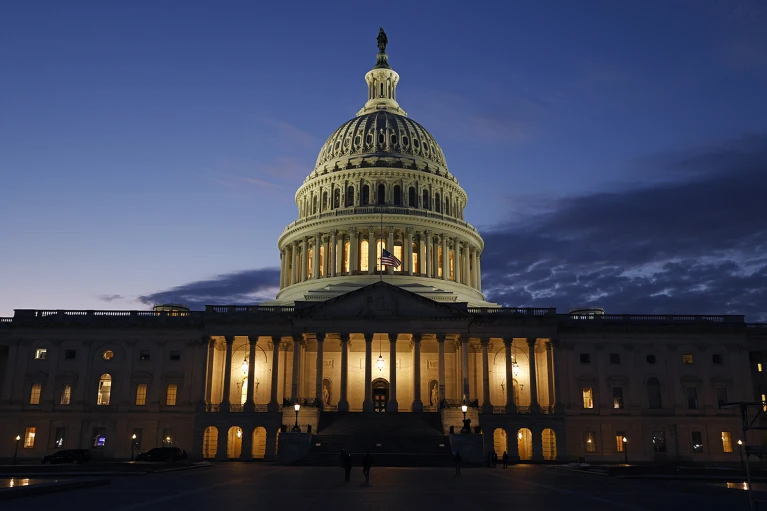
In early February, the United States Congress pushed back against sweeping reductions to federal science budgets that had been proposed for 2026 under President Donald Trump’s administration. Lawmakers rejected what many described as unprecedented cuts to research spending. Yet weeks after the budget bill was signed into law, money allocated to key scientific agencies has not been moving at the usual pace.
At the center of the delay is the White House Office of Management and Budget, commonly known as OMB. Although Congress approved funding for major research institutions, OMB authorization is required before agencies can fully access and distribute those funds. So far, the National Institutes of Health has not received clearance to spend any of the research money provided under the new law enacted on 3 February. The National Science Foundation was only recently given approval to begin using its allocated funds. NASA has technically been granted access to its full budget, but with an unusual caveat: it cannot spend money on ten specific science programs until further notice.
OMB has not publicly clarified when the remaining approvals will be issued. In previous statements, OMB Director Russell Vought has described the office’s authority over federal spending as an essential legal mechanism. According to him, oversight ensures agencies do not misuse taxpayer dollars and remain aligned with White House priorities. He has also argued that OMB retains the ability to apportion less funding than Congress initially appropriated.
Critics in Congress see the situation differently. Representative Rosa DeLauro of Connecticut, a senior Democrat on the House committee responsible for drafting spending legislation, characterized the approach as a sharp break from longstanding budget practice. Together with Senator Patty Murray of Washington, her counterpart in the Senate, DeLauro has urged OMB to release the funds promptly, emphasizing that federal law requires the executive branch to carry out Congress’s spending decisions. Republican committee chairs have not publicly commented on the issue.
Under typical circumstances, once a full-year federal budget is enacted, agencies automatically gain access to a portion of their annual funding in 30-day increments. This rolling authorization continues until OMB formally approves an agency’s detailed spending plan, at which point broader access to funds is unlocked.
However, for fiscal year 2026, OMB revised its procedures. In August, it updated Circular A-11, an internal guidance document sometimes referred to as the “Budget Bible.” The revision narrowed the scope of what agencies can cover with those initial 30-day allocations, limiting expenditures largely to essential operational costs such as salaries. Policy experts say the change effectively strengthens White House control over how and when agencies deploy congressionally approved resources.
The consequences have been particularly significant for the National Institutes of Health, the world’s largest public funder of biomedical research. Until its newly appropriated funds are released, NIH must rely on leftover money from a temporary funding measure passed last November. That stopgap legislation was intended to bridge the gap until the new budget was finalized. It has provided roughly one-third of NIH’s $47 billion annual allocation. As a result, new research grants have slowed dramatically.
The slowdown at the National Science Foundation has followed a similar pattern. NSF supports approximately one-quarter of all federally funded basic research conducted at US colleges and universities. For several weeks after the budget bill was signed, the agency was largely restricted to paying staff salaries and maintaining essential operations, including management of research facilities such as Antarctic field stations. Only last week did OMB authorize NSF to begin distributing its research funds for 2026, roughly three weeks after presidential approval of its budget.
These administrative bottlenecks come on top of an already disruptive fiscal year. A record 43-day federal government shutdown between October and November halted many grant reviews and paused routine agency work. Combined with the current funding delays, the impact on grant-making has been severe. Since the fiscal year began on 1 October, NIH has awarded only about 30 percent as many new research grants as it had by the same point in each of the previous six years. At NSF, the comparable figure is roughly 20 percent.
An NSF spokesperson has indicated that, now that full-year funding authority is in place, the agency expects research award activity to resume while continuing to support critical scientific work. NIH and White House representatives have directed inquiries about the delays back to OMB, which has yet to provide further explanation.
At NASA, the situation is somewhat different but equally notable. In a footnote attached to a 21 February budget notice, OMB informed the agency that it must provide additional justification before spending newly allocated funds on ten designated science programs. These projects include planned missions to Venus, efforts to study a potentially hazardous asteroid, and several Earth-observing satellites. Normally, once Congress approves NASA’s budget, the agency has broad discretion to move forward with its missions.
NASA Administrator Jared Isaacman has suggested that the restriction reflects routine discussions between the agency and the White House about mission funding priorities. However, space policy observers argue that such limitations are unusual. Advocacy groups note that Congress had expressed clear bipartisan support for many of the affected programs, some of which involve international partnerships. Delays could therefore have global implications, potentially affecting collaborative agreements and long-term mission planning.
This is not the first time OMB has imposed targeted spending restrictions. Last July, the office temporarily limited NIH’s ability to use newly appropriated funds for anything beyond salaries and emergency costs. That freeze was lifted shortly after media coverage brought attention to the issue.
The broader concern now is whether agencies will be able to recover lost ground. Last year, after funding was reduced or delayed, both NSF and NIH faced intense pressure to spend their remaining budgets before the fiscal year ended on 30 September. At NSF, nearly the entire $9 billion allocation was ultimately used, but the agency issued roughly 20 percent fewer new grants than in the prior year. NIH experienced a similar contraction, awarding about 24 percent fewer new grants compared with its average over the previous decade. In some cases, the agency provided multi-year funding to projects in a single installment to ensure it met budget deadlines.
Observers worry that a repeat scenario could unfold in 2026, potentially with even greater disruption. If NIH and NSF are unable to distribute funds steadily throughout the year, they may once again be forced into a late-year spending surge. Such compressed timelines can strain administrative systems, complicate long-term research planning, and heighten uncertainty for scientists awaiting grant decisions.
Former NIH official Michael Lauer, who oversaw the agency’s external research funding operations for nearly a decade, has cautioned that prolonged delays could unsettle both agency staff and grant applicants. Research institutions depend heavily on predictable federal funding cycles to sustain laboratories, support graduate students and postdoctoral researchers, and maintain continuity in long-term projects.
For the broader scientific community, the stakes are high. Federal research funding underpins advances in medicine, engineering, climate science, and space exploration. Even temporary slowdowns can ripple through universities, startups, and international collaborations. While Congress has reaffirmed its commitment to supporting US science, the timing and mechanics of budget execution now play an increasingly visible role in determining how quickly discoveries move from proposal to practice.
As the fiscal year progresses, researchers across the country are watching closely, hoping that administrative hurdles will soon be cleared and that the flow of grants can return to a more predictable rhythm.
Leave a Reply