
-

“NAM Special Report Highlights Need for National Strategy and Health Equity to Bolster U.S. Biomedical Research”
•
The National Academy of Medicine’s report highlights significant challenges facing U.S. biomedical research, including fragmented funding and workforce issues. It proposes a strategic roadmap for improvement, focusing on health equity, federal coordination, and a well-supported workforce. The goal is to optimize research for better health outcomes and sustained global leadership in science.
-

A Fresh Perspective on American Science
•
America’s scientific leadership results from sustained federal investment and international collaboration. However, shifting global dynamics and increased industry funding challenge this dominance. The VAST task force aims to propose innovative policies for workforce development, infrastructure modernization, and public engagement. Adaptation is essential for U.S. science to continue driving global progress and prosperity.
-

“STEM Education in Rural Communities Holds Great Potential, Requiring Focused Resources, Connectivity, and Training”
•
A report by the National Academies recommends strategies to enhance STEM education in rural U.S. communities. It emphasizes leveraging local resources, improving broadband access, simplifying funding applications, and fostering partnerships to create relevant learning experiences. Key obstacles include limited infrastructure and funding challenges, which the report addresses with actionable recommendations for policymakers and educators.
-

“Science and Technology Are Becoming the New Currency of Power”
•
Darío Gil, IBM Research’s senior vice president, leads a major corporate laboratory focusing on AI, quantum computing, and hybrid cloud. As chair of the National Science Board, he emphasizes collaboration across sectors to address U.S. scientific challenges, improve STEM education, and foster global scientific partnerships. His vision strives for innovation and societal engagement in…
-

“The Invisible Hand of Universities”
•
On March 12, 2025, Marcia McNutt and Michael Crow discussed American science’s challenges amid the second Trump administration. They voiced concerns over budget cuts impacting research and innovation. The conversation emphasized the necessity of investing in STEM education and interdisciplinary research to maintain economic leadership and prepare future scientists for diverse careers.
-

The Role of International Talent in Driving U.S. Prosperity
•
The reinstatement of international student visas is a positive step, but the U.S. must ensure stable policies to attract global talent. International students enhance academic excellence, drive innovation, and contribute significantly to the economy. Their presence supports workforce needs, fosters collaboration, and helps maintain America’s competitive edge in technology and research.
-

New Report Outlines Future of Particle Physics, Recommends U.S. Start Building Ultimate Particle Collider
•
The National Academies of Sciences recommends realigning U.S. biomedical research funding to better address prevalent diseases like cardiovascular disease and chronic pain. It calls for the establishment of a federal consortium, improved coordination among agencies, and innovative payment models to ensure that treatments meet actual health needs and facilitate patient access.
-
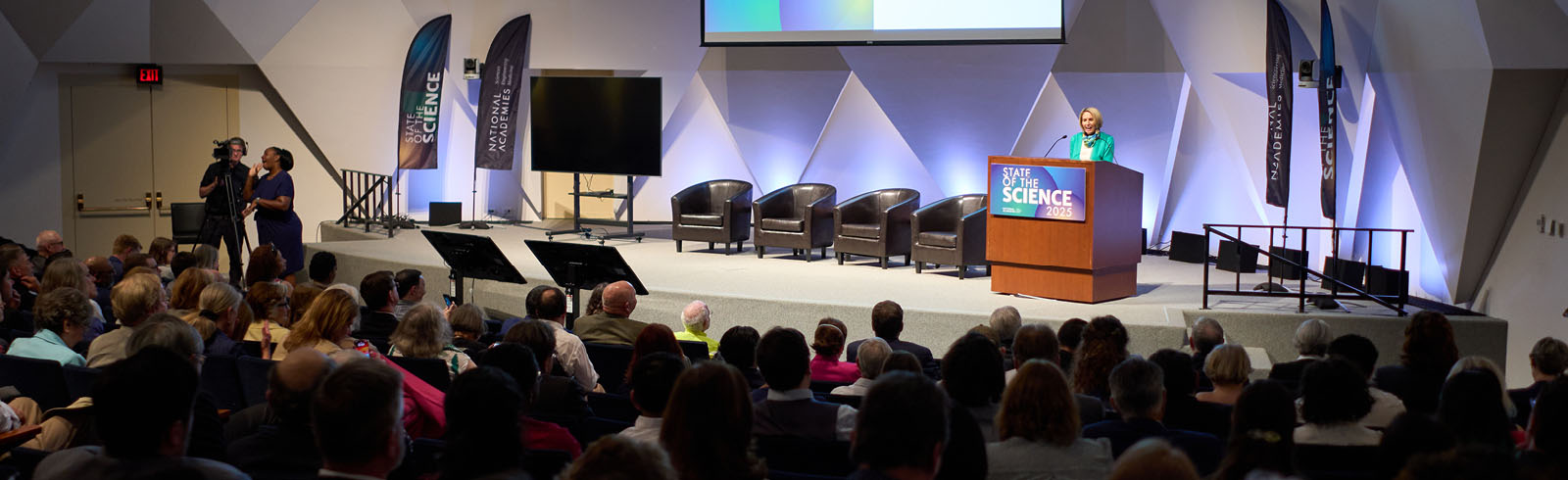
NAS President Warns of a ‘Bleak’ Outlook for U.S. Science, Calls for Reforms to Restore Global Leadership
•
On June 3, NAS President Marcia McNutt addressed significant challenges to U.S. science and technology in her State of the Science speech. She urged immediate action to combat budget cuts and regulatory burdens, proposing seven strategies, including fostering innovation, improving education, and rebuilding public trust, to restore U.S. scientific leadership.
-

Aligning Federal Investments in New Disease Treatments With Americans’ Unmet Health Needs
•
The National Academies of Sciences urges a realignment of U.S. research funding to better match the disease burden affecting Americans. The report highlights imbalances in funding priorities, especially for common diseases, and suggests creating a federal consortium to address unmet medical needs, improve collaboration, and ensure effective therapeutic developments.
-

A Timeless Guide to Ethical Research Receives a Modern Update
•
The U.S. National Academies of Sciences is revising its ethics guide, On Being a Scientist, to address contemporary ethical challenges linked to AI and data-driven research. The forthcoming edition will adapt timeless principles to modern realities, promoting responsible conduct and transparency while remaining accessible in a digital format. It aims to inspire a commitment…